Major Decision
How to Decide Where to Live Internationally
By Frank L. van Houten · Borderless Decisions
Choosing where to live internationally is not just a geography question. It is a decision about the kind of life the next chapter should support.
At some point, many people find themselves asking a deceptively simple question: Where should we live?
On the surface, it sounds straightforward. Compare cities. Evaluate costs. Consider lifestyle. But in reality, this decision is rarely just about geography.
It is about career direction, family priorities, financial structure, lifestyle preferences, and the kind of life you want to build over the coming years. That is why this decision often feels more complex — and more consequential — than expected.
Why this decision is harder than it seems
Most people try to answer this question by focusing on one or two factors: the career opportunity, the lifestyle appeal, or the cost of living. Those matter, but important decisions rarely belong to a single category.
A career opportunity may require relocating to a country that does not align with long-term lifestyle goals. A desirable lifestyle location may limit professional options. A financially efficient option may create trade-offs elsewhere. When decisions are approached in isolation, they often feel uncertain — or lead to outcomes that need to be revisited later.
Clarity tends to emerge not by focusing more narrowly, but by stepping back and seeing the full picture.
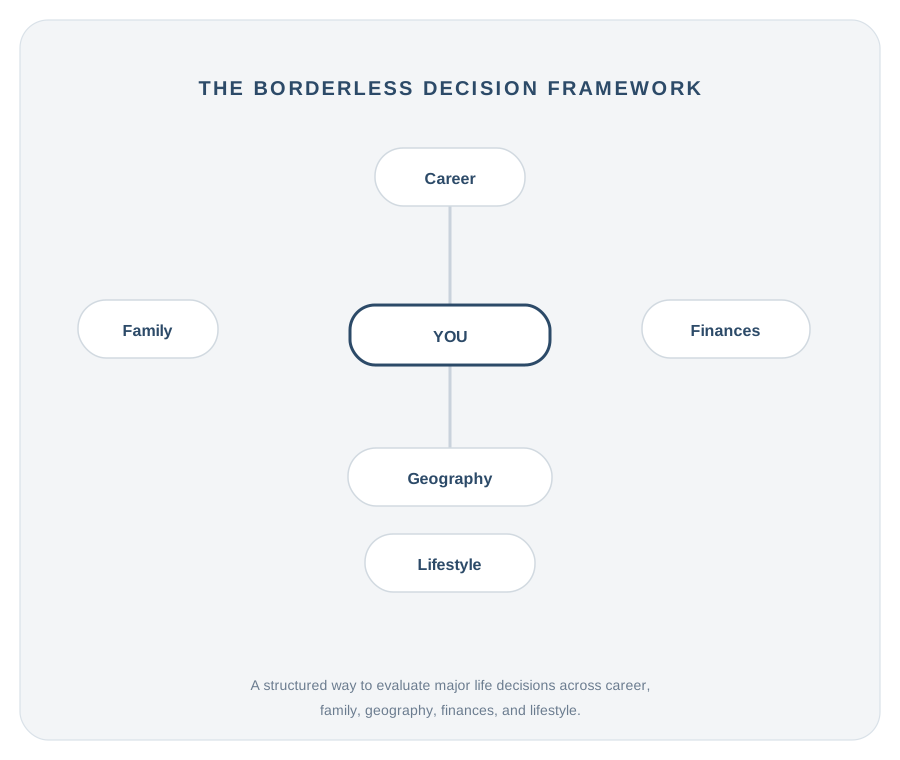
The five dimensions in The Borderless Decision Framework
One way to approach this decision is to look at it through five interconnected dimensions:
- Career: What opportunities are available, and how does this location influence long-term professional development?
- Family: What are the needs, preferences, and constraints of the people closest to you?
- Geography: What does daily life actually look like in this place — not just on paper, but in practice?
- Finances: What are the implications for income, cost of living, taxes, and long-term financial structure?
- Lifestyle: What pace of life, environment, and culture does this location offer?
No single dimension determines the answer. What matters is how they interact.
A decision becomes clearer when all five dimensions are considered together. Looking at only one factor can make an option seem stronger than it really is.
The role of trade-offs
Every location involves trade-offs. A city that offers strong career opportunities may come with a faster pace of life. A location that provides a more relaxed lifestyle may offer fewer professional options. A place that works well financially may not align with long-term personal priorities.
The goal is not to eliminate trade-offs — that is rarely possible. The goal is to understand them clearly. When trade-offs are visible, decisions tend to feel more grounded and less uncertain.
Common patterns people encounter
Over time, a few patterns tend to appear in these decisions:
- Opportunity and lifestyle rarely align perfectly. The places that are most attractive professionally are not always the places people ultimately want to live long-term.
- Timing matters. A location that makes sense at one stage of life may not make sense later.
- Flexibility vs commitment. Decisions such as buying property can provide stability, but also reduce flexibility.
- External factors shape internal decisions. Family, education, and relationships often influence choices as much as professional considerations.
Recognizing these patterns can make the decision feel less isolated — and more structured.
A different way to approach the decision
Instead of asking, Which place is best? it can be more useful to ask:
- How does each option perform across all five dimensions in The Borderless Decision Framework?
- Where are the trade-offs acceptable — and where are they not?
- What matters most at this stage of life?
- Which choice aligns best with the direction we want to move in?
This shift in perspective often reduces the pressure to find a “perfect” answer and replaces it with a clearer understanding of the options.
The cost of unclear decisions
Without a structured way to think through this decision, people often delay making it, move forward with incomplete clarity, commit to paths that later need to be reversed, or carry ongoing uncertainty about whether they chose well.
Given the impact these decisions can have, taking the time to evaluate them properly is often worthwhile.
Bringing the full picture into view
Deciding where to live internationally is not just a logistical question. It is a decision that shapes daily life, professional direction, financial structure, and long-term trajectory. Clarity tends to emerge when all of these elements are considered together rather than separately.
When a conversation can help
Some decisions benefit from stepping back and discussing the full landscape with someone who understands the complexity involved. If you are evaluating where to live — or comparing multiple options — a structured conversation can help bring greater clarity to the decision.
Start a Conversation